Inference Synthesis
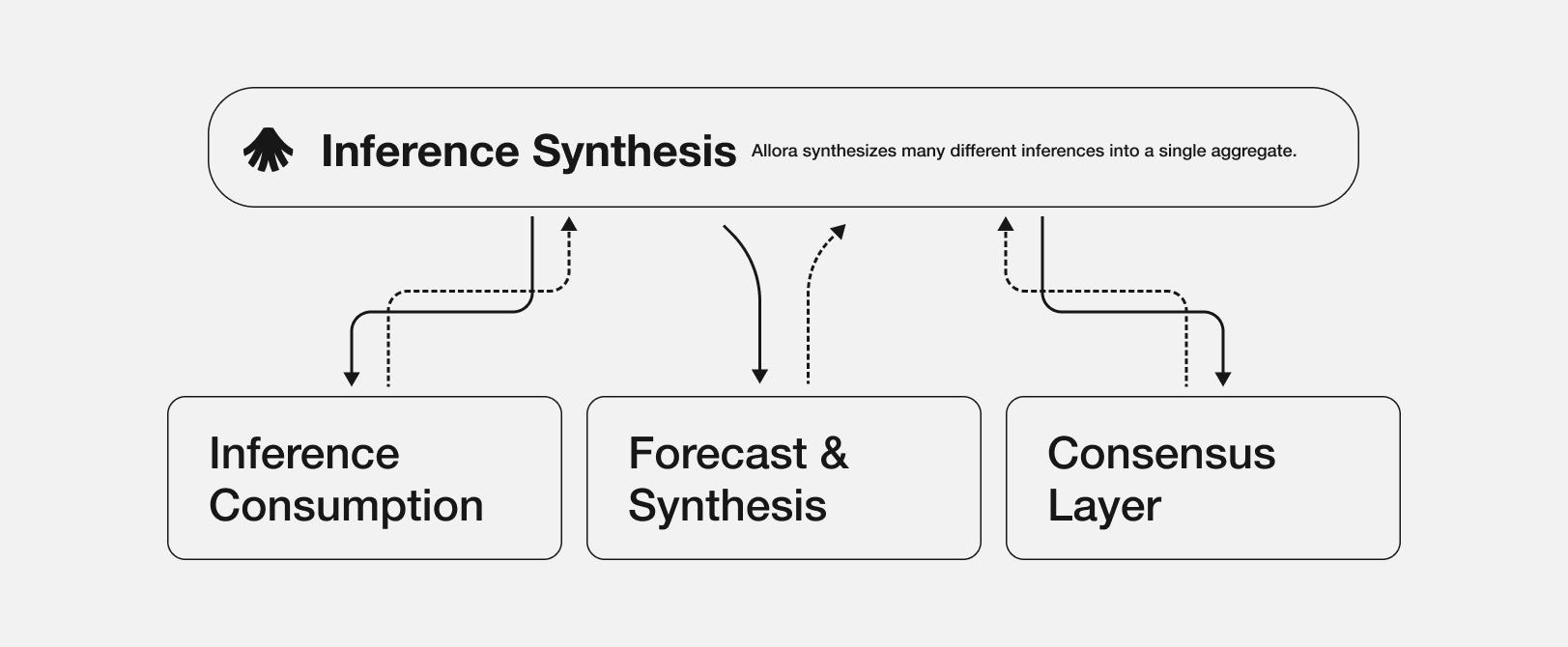
The Allora network operates through three distinct layers:
- Inference Consumption Layer: Facilitates the exchange of inferences.
- Forecasting and Synthesis Layer:
- Inference workers provide inferences.
- Forecasting workers use models to predict the accuracy of these inferences.
- The Inference Synthesis mechanism aggregates results for consumers.
- Consensus Layer:
- Manages rewards and economics for network participants.
- Ensures a permissionless and secure environment for transactions.
This page covers the first two layers: how inferences are exchanged, forecast, and synthesized into a single network inference. The consensus layer — rewards and economics — is covered in Consensus and Rewards.
Inference Consumption
Request/Response Flow
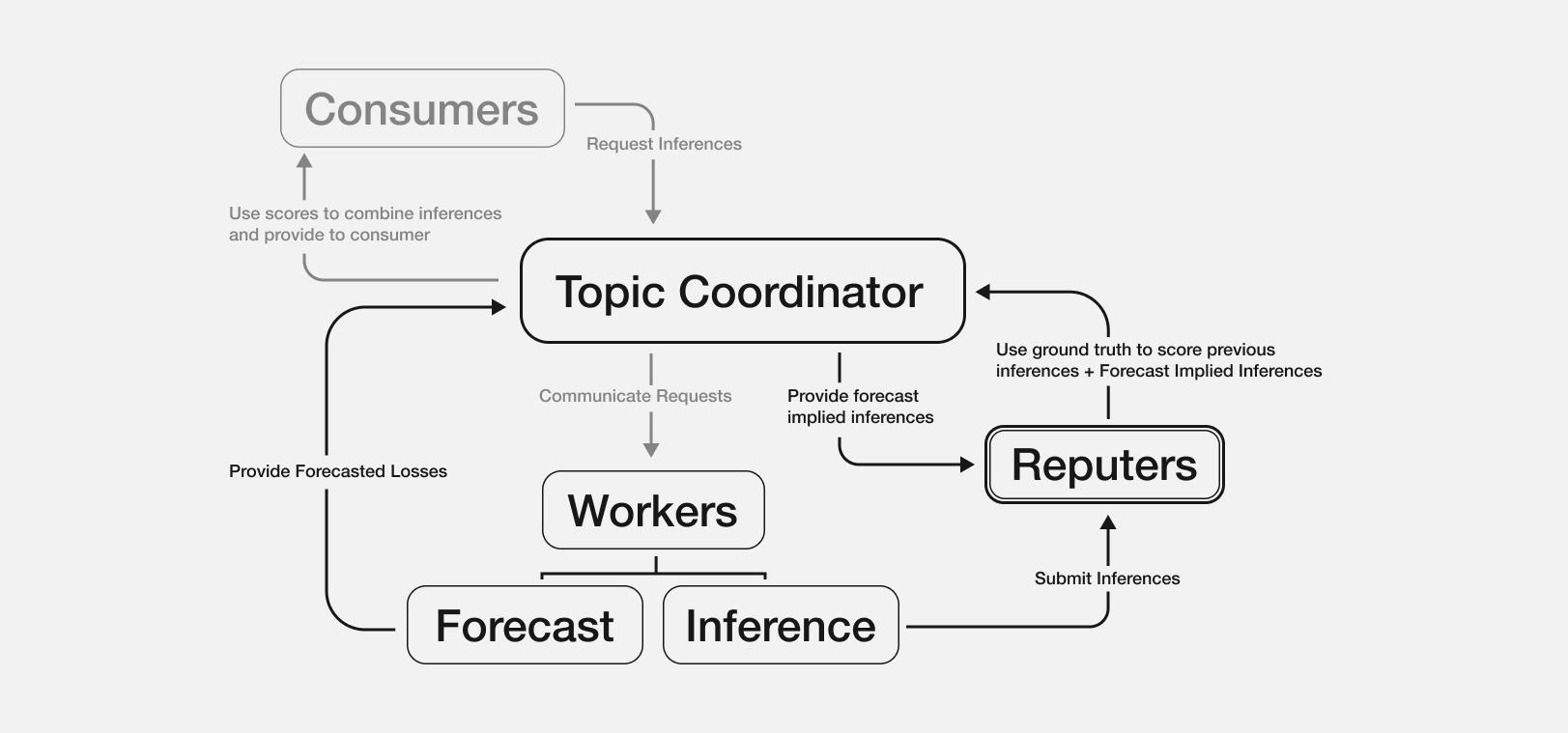
At its core, Allora facilitates the exchange of inferences, enabling Consumers to request them and Workers to supply them.
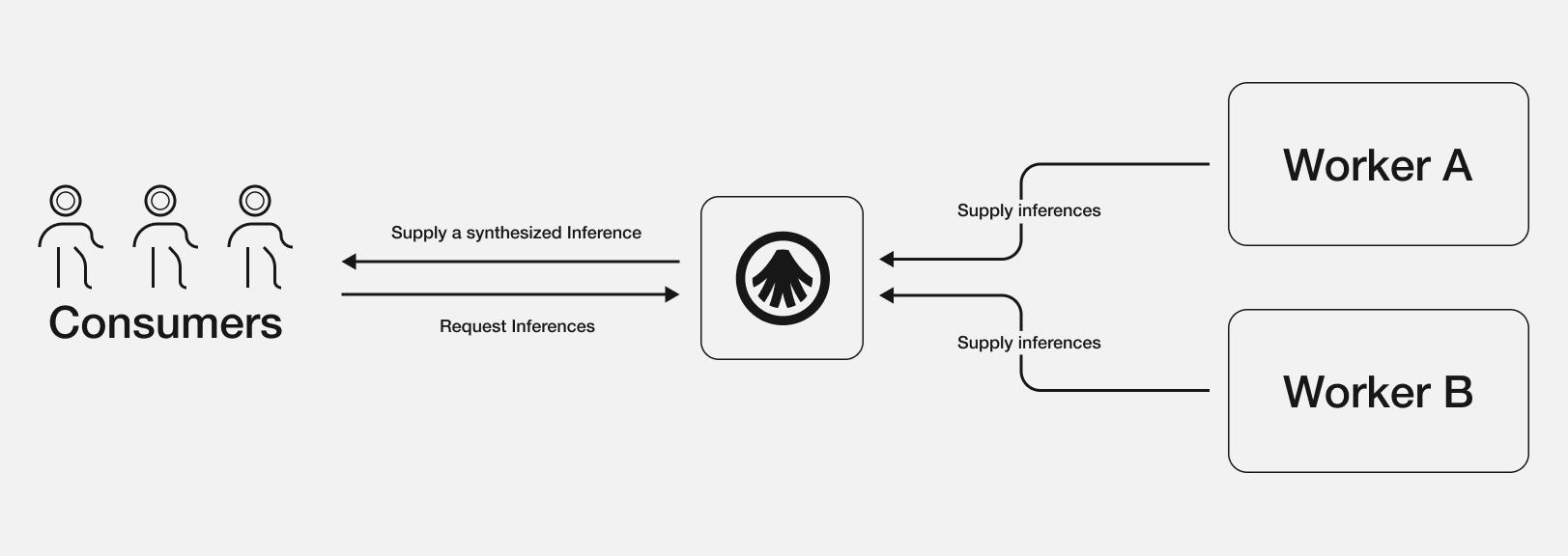
Learn how to query data and inferences offchain and onchain for a given topic.
Topic Coordination
Inferences are categorized using Topics. Anyone, including network participants, can permissionlessly create topics to coordinate network collaboration. A single topic is stored inside a Topic Coordinator and is identified using a rule set, which consists of a target variable and a loss function which are used to score topic inferences.
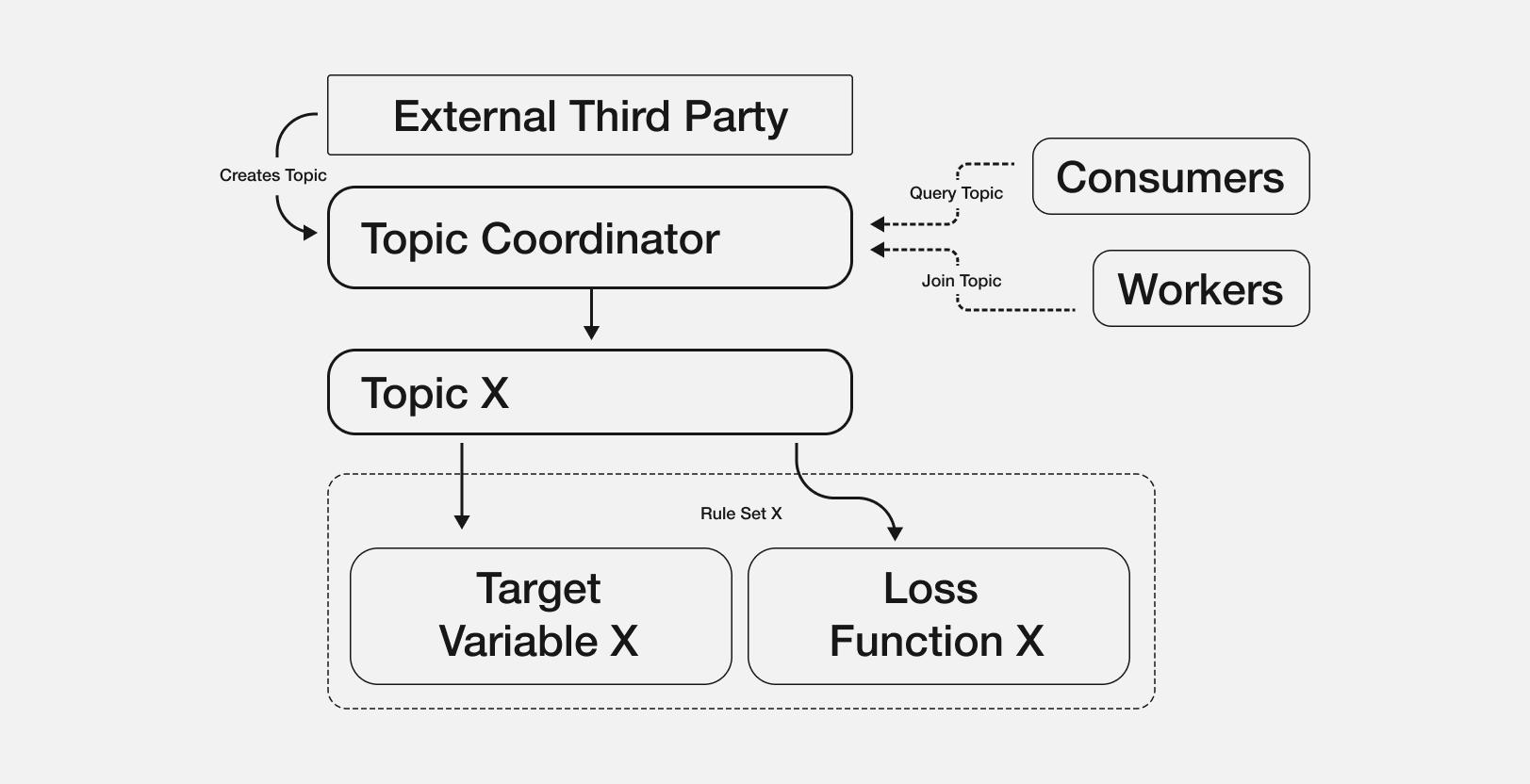
Inferences have a topic life cycle that governs their stages from creation to conclusion.
Reputers
As the number of workers in the network increases, some will naturally perform better than others due to the system's permissionless nature. To maintain quality and help the network set the reward distribution, Reputers evaluate each worker's performance against the ground truth when it becomes available.
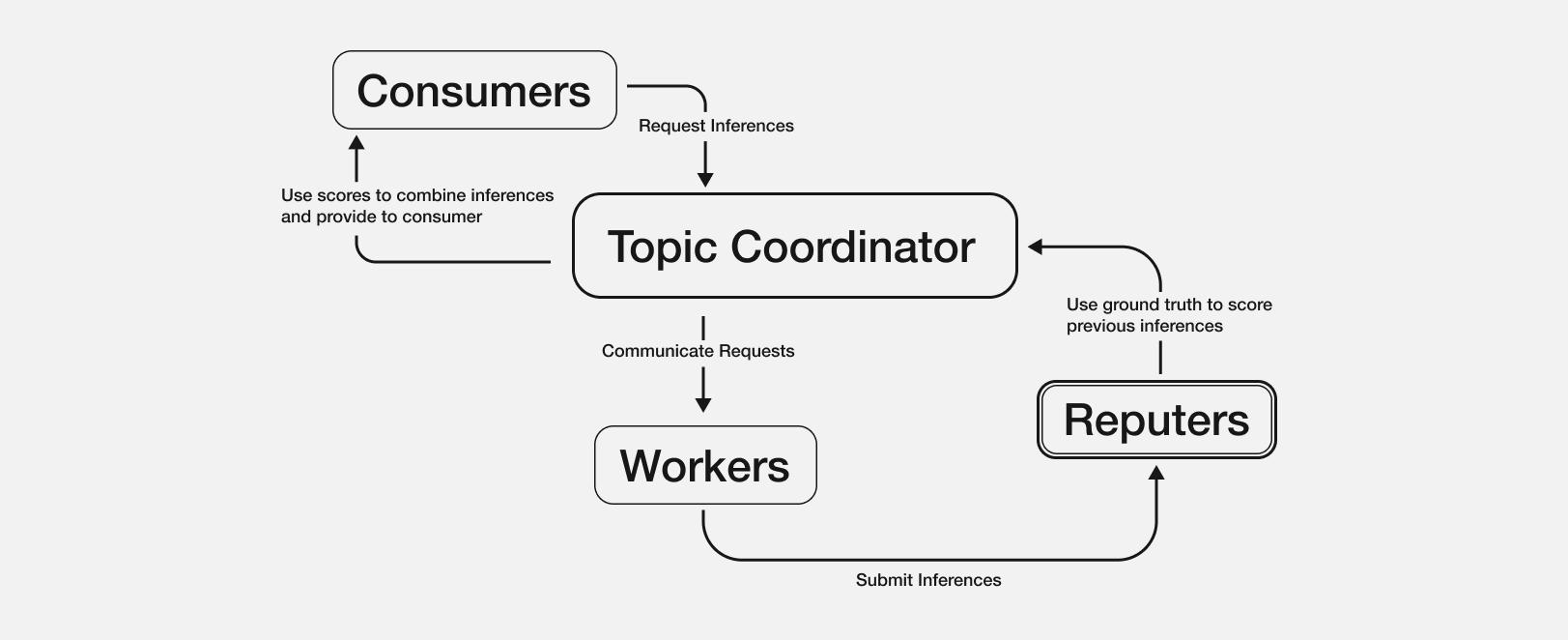
The final architecture of the inference consumption layer shows how consumers request inferences, how workers supply them, and how reputers verify the accuracy of inference workers.
Forecast and Synthesis
Inferences are scored by forecast workers and combined by the topic coordinator to deliver a single synthesized inference to the consumer that is a weighted combination of all individual inferences.
Let's dive into this process in the following sections.
Forecast
Context Awareness
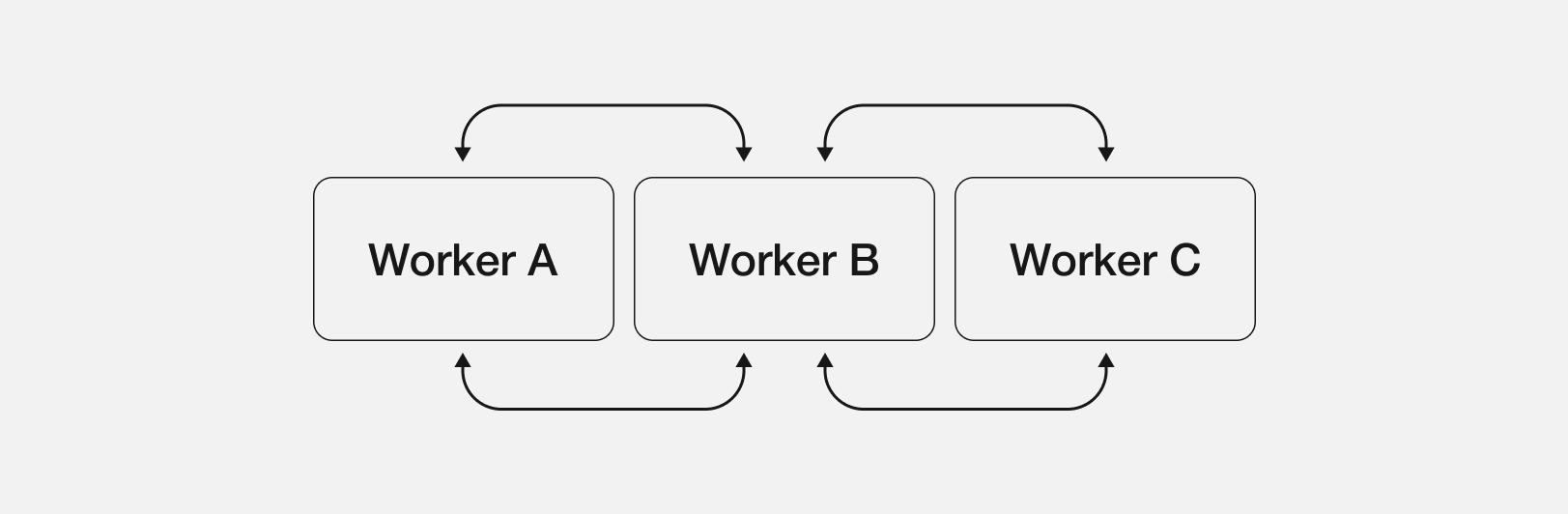
Some workers function to forecast the expected performance of other workers inferences' and make the network Context Aware. Context awareness enables the aggregated inference produced by the network to be better than any individual model's output.
Inference Synthesis is greatly enhanced due to the context awareness of the workers.
Losses
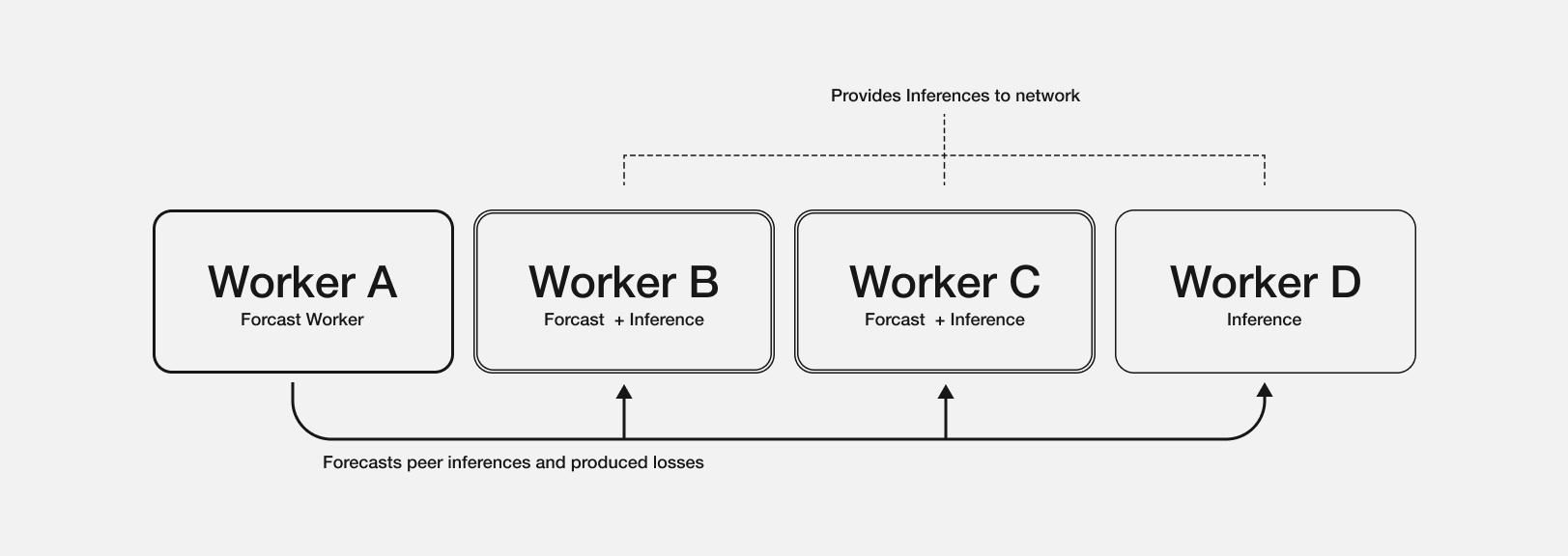
Some workers forecast, some workers produce inferences and some do both. Forecast workers use their own data and models to predict the accuracy of produced inferences, generating forecasted losses.
Forecasted losses allow the network to become context aware.
Regrets
Forecasted losses are used to calculate regret, which indicates how much better or worse each inference is expected to be compared to previous inferences. Positive regret means an inference is expected to be more accurate than the network inference, while negative regret means it is expected to be less accurate.
Regrets are used to generate weights, where more accurate inferences get higher weights.
Losses and weights are collectively used to synthesize inferences. Let's dive into how inference synthesis works in the next section.
Synthesis
Inference synthesis in Allora is a process that combines individual inferences from various workers to produce an aggregate inference. This process takes place at each epoch and involves both inference and forecasting tasks.
Normalization of Regrets
Regrets are normalized to ensure weights are comparable and within a reasonable range.
This allows the use of a single mapping function to map regrets to weights, independently of the absolute scale of the losses and regrets. The regret is normalized using its standard deviation across all workers, adjusted by a small constant 𝜖:
- Here, 𝜎𝑗 is the standard deviation of 𝑅𝑖𝑗𝑘 for a particular inference across all workers.
- The small constant 𝜖 ensures numerical stability and avoids division by zero.
Using Normalized Regrets for Weights
The normalized regrets 𝑅𝑖𝑗𝑘 are then used to calculate the weights for each inference:
These weights determine how much each raw inference 𝐼𝑖𝑗 will contribute to the final network inference.
Forecast-Implied Inferences
The Topic Coordinator takes the forecasted losses and normalized weights and produces forecast-implied inferences. A forecast-implied inference is a predicted value of a target variable that combines different forecasters' predictions and workers' inferences, where each prediction is weighted based on how accurately the forecasters predicted losses in previous time steps, or epochs.
Here, 𝑤𝑖𝑗𝑘 are weights assigned to each inference based on the forecasted regret.
Final Network Inference
The final inference for the network is a weighted combination of all individual inferences following a procedure similar to the generation of forecast-implied inferences discussed above, but using the actual regrets based on the losses provided by reputers instead of forecasted losses. This combined result is expected to be more accurate and reliable due to the weighting process.
Multi-Label Topics
Since v0.17.0, synthesis is label-aware. For multi-output topics, the process above runs independently for each label, and the result is returned as a network inference bundle — a set of labeled values rather than a single number. A single-output topic is simply the special case with one canonical label (y), so its bundle carries a single value.
For classification topics that set require_unity, the per-label outputs are constrained to sum to one (within the topic's unity_tolerance), so the bundle represents a probability distribution across the labels.
The outlier-resistant network inference is only computed for single-label regression topics; it is not produced for multi-label topics.